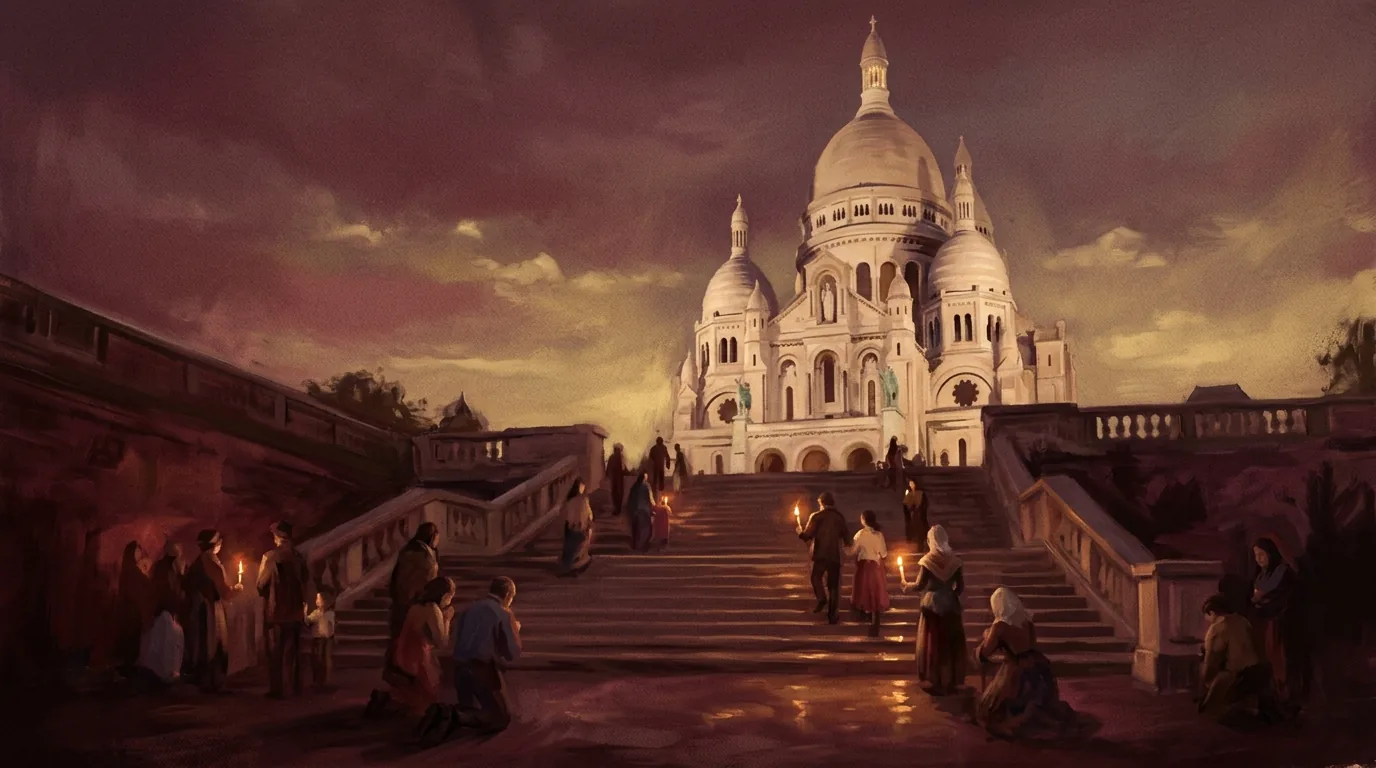
The year is 1871, and the streets of Paris are stained with blood and ash. France has just suffered a humiliating, crushing defeat in the Franco-Prussian War, and the city itself has been torn apart by the violent, chaotic uprising of the Paris Commune. The nation is spiritually and physically broken. Amidst this profound despair, two faithful laymen, Alexandre Legentil and Hubert Rohault de Fleury, look at the smoking ruins of their beloved country and realize that political treaties will not heal the deep wounds of France.
They need a spiritual resurrection. Together, they draft a "National Vow," a solemn promise to build a magnificent basilica dedicated to the Sacred Heart of Jesus, high atop the highest point in the city: the hill of Montmartre, historically known as the "Mount of Martyrs." It was to be a monument of national repentance, a plea for divine mercy, and a beacon of hope.
The construction took decades, funded not by wealthy aristocrats or government grants, but by the pennies and small donations of ordinary French citizens. Finally, in 1919, just after the guns of World War I fell silent, the breathtaking white travertine domes of the Sacré-Cœur Basilica were officially consecrated, gleaming like a crown over the Parisian skyline.
Yet, the true miracle of Montmartre is not its stunning architecture, its massive bells, or its panoramic views of Paris. The true miracle happens inside, in the hushed, golden glow of the sanctuary. On August 1, 1885, long before the building was even finished, a priest placed the Blessed Sacrament in a monstrance on the high altar, and a group of faithful knelt to pray.
Since that very day, the prayer has never stopped. Not through the terrifying bombings of World War II, not through the tense Nazi occupation of Paris, not through the global pandemics of the modern era. For well over a century, 24 hours a day, 7 days a week, an unbroken chain of volunteers has maintained a constant vigil of Eucharistic Adoration.
In the dead of night, while the bustling city of Paris sleeps, there is always someone kneeling under the great mosaic of Christ, keeping watch, offering the world’s brokenness to the healing fire of the Sacred Heart.